Click Here


Home


News Blog


Fixtures/Results


Officers


Clothing


Photo Galleries


Tours


Statistics


Player Profiles


Hall of Fame


History


Archive


Links


Other sites

OC Hockey Club

OC Rugby Club

OC Society

Cranleigh School

Previous Posts

Powered by Blogger

Subscribe to
Posts [Atom]


Monday, 8 March 2010

New awards unveiled at annual dinner
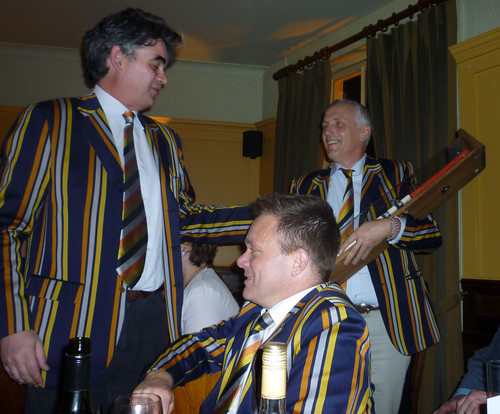

Around 50 Old Cranleighans and a few current Cranleighans attended the annual-when-the-committee-remembers dinner at The Alma in Wandsworth. For the first time three awards were made - Batsman of the Year, Bowler of the Year and Player of the Year. There was also an auction to raise money for the Friends of Tim Evans Trust and in all more than £1100 was collected.

After drinks and an excellent meal, Michael Chetwode gave a rare and very witty speech, honouring Martin Williamson for his contribution to the club over the last 30 years, both on and off the field. Suffice to say tales of losses on shares, Coppers Doggers and other embarrassing escapades were dusted off. Peter Shelley, who as captain in 1980 recruited both Chetwode and Williamson into the club, then read out a highly amusing, largely fictitious, and repeatedly libellous letter from Williamson to him asking to play in the 1980 cricket week. Williamson was then presented with a cricket bat signed by many club members and mounted in a wooden case. He gave a short speech of thanks.

Club president David Bugge, steadfastly wearing a traditional OC blazer, gave a brief speech highlighting the success of recent years and flagging Rick Johnson would be proposed for inclusion in the Hall of Fame at the next AGM.

Before the awards came the fines. With Eds Copleston sidelined with a painful disease, it fell to the far more aesthetic Sophie Cook to dish out the punishments to the usual suspects. Several people noted it was Copleston’s least badly-behaved evening in recent memory.

The Batsman of the Year was a product of our youth policy, Henry Watkinson; the Bowler of the Year went to Ed Henderson; while the Player of the Year, again looking to the future, was a rather staggered Chetwode.

The evening ended with a raffle and auction for the Friends of Tim Evans Trust. John McDermott acted as auctioneer, making a trademark speech and crossing a new boundary by describing the headmaster’s wife, who was in attendance, as a “a little bit of crumpet”.

Labels: , , , , ,

Thursday, 5 April 2007

Shelley and Heard enter Hall of Fame


Peter Shelley and Dick Heard have been admitted to the OCCC Hall of Fame. They are the sixth and seventh OCs to be admitted.

Peter Shelley led the side between 1975 and 1981, and was responsible for rebuilding it into a vibrant club, recruiting many of the players who made it so successful under his successor, David Bugge. Always cheerful and extremely popular with both OCs and opponents, Peter always tried to ensure the game was played in the right spirit, leading by example with hardly ever a cross word.

He was also one of the finest wicketkeepers to be produced by the school, and was possibly the last in a long line of specialist keepers. He was probably at his best standing up to medium pacers – and art not seen often these days – and such was his anticipation and footwork that he rarely had cause to fling himself around to take balls. His batting was idiosyncratic – he was a genuine No. 11 even though he occasionally treated himself to a spot higher up the order – and his running between wickets a sight to behold.

Peter’s family's OCCC representation probably goes back further than any other. His grandfather played for the club at the turn of the century, and his father and uncle both turned out in the 1930s.


Dick Heard
played in the same side as Peter’s father, and was one of the most natural sportsmen turned out by Cranleigh in the 1920s. He played rugby for the OCRFC in the opening match at TD, but it was at cricket he really excelled.

He was in the Cranleigh side which played at The Oval in 1928, and later that summer played for Surrey Young Cricketers. His leaving Cranleigh coincided with the Depression and in 1929 and 1930 he played cricket almost non-stop. In 1929 he scored 3000 runs in the season, including a hundred in 29 minutes for Wanderers at Leatherhead and 88 in 24 minutes at Gravesend. His bowling was also in demand – in 1931 he took eight wickets in an innings twice. He started playing for the OCCC in 1928, being the leading scorer between 1929 and 1935 and scoring 505 runs in 1931, a record which stood for over fifty years. He captained the side in 1935, but work commitments meant that he did not play after the war.

He continued to live in Thames Ditton until his death in 2002 at the age of 92.

Labels: ,


Copyright © 2011 Old Cranleighans. All rights reserved.